Guide
Your fertile window explained
Last updated: October 2026

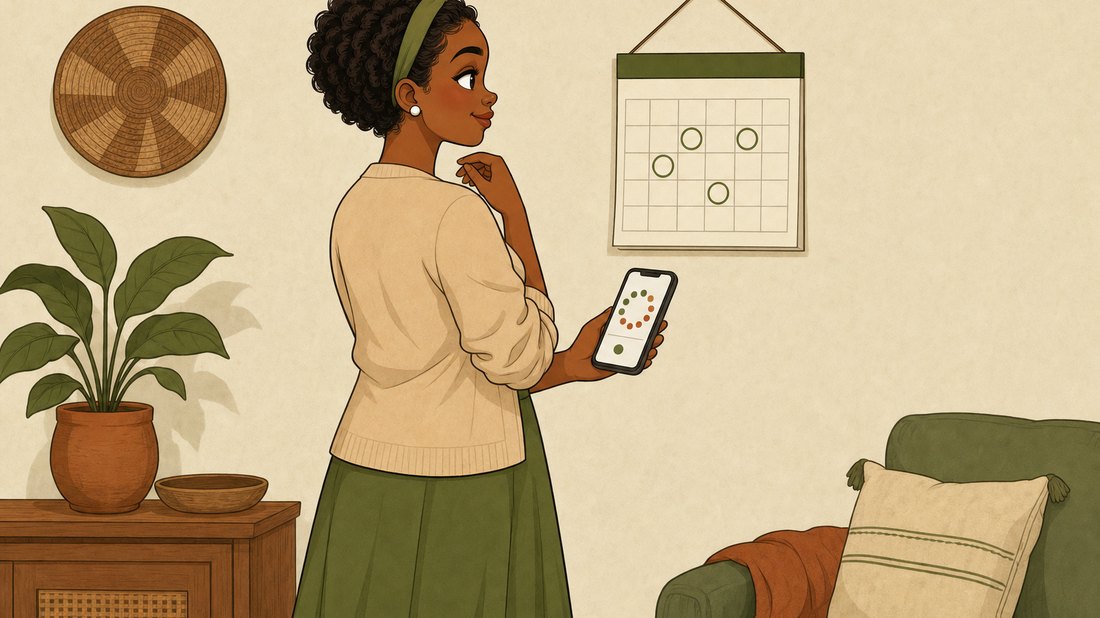
You cannot conceive on most days of your cycle. The window is about six days long. Knowing where yours falls takes off some of the pressure, because it shows you which days do not matter.
What is the fertile window?
Ovulation is the release of an egg from an ovary. That egg survives about a day. Sperm survive far longer, up to about five days inside the body. Sex several days before ovulation can still result in a pregnancy.
The window is the five days before ovulation plus the day itself, roughly six days. Most of it sits before ovulation and not after. If you wait until you are sure you have ovulated, you have largely missed it.
Why is day 14 wrong for most women?
The day 14 rule comes from a 28-day cycle, and most cycles are not 28 days. The National Health Service puts the normal range at 21 to 35 days, so ovulation can move by two weeks across that range.
Counting forward from your last period is the mistake. Ovulation is better estimated backwards, because the second half of the cycle is the steadier half. The National Health Service puts the time from egg release to the start of a period at around 10 to 16 days. So even the steady half has a six-day spread. That is why a calculator gives you a window and not a date.
An analysis of 7,043 women's tracked cycles, published in the Journal of Medical Internet Research, found this: most of the variation in cycle length sits in the first half, before ovulation, and assuming a mid-cycle release performs poorly. A method built on the backwards count did better than the mid-cycle assumption.
To use this, find your own average cycle length over three or four months with the period tracker, then let the ovulation calculator do the subtraction.
What signs does my body give when I am fertile?
Three signs are worth learning. They are not equally useful.
- Cervical mucus. Clear, stretchy and slippery like raw egg white means the window is open now. This is the only common sign that points forwards, so it is the most useful one for timing.
- A small temperature rise. Your resting temperature lifts slightly after ovulation. It confirms that ovulation happened. That helps you learn your pattern, but it cannot help you catch this month, because by the time it rises the egg is going or gone.
- A one-sided twinge. Some women feel it, many do not, and it is not reliable enough to plan around on its own.
If you want more than an estimate, ovulation predictor strips detect the hormone surge a day or two before release, and a clinic can scan and see it directly. Both tell you more than any calendar.
How often should we have sex without it becoming a job?
You do not have to hit one exact day, and trying to is how couples end up dreading the middle of the month. Sex every two or three days across the cycle covers the window without anyone having to check a chart first. It also removes the argument about whether tonight counts.
There is no evidence that saving up improves your odds, and long gaps can work against you. Regular works better than strategic.
Can I use the fertile window as contraception?
No. Everything on this page estimates from a pattern, and a pattern cannot see the month your body behaves differently. That is exactly the month that matters. Illness, travel, stress and weight change all move ovulation. The uncertainty that makes this fine for trying makes it a poor tool for avoiding pregnancy.
Although both women and men can experience infertility, women in a relationship with a man are often perceived to suffer from infertility, regardless of whether they are infertile or not.
Hold onto this while you count days. A window timed perfectly still needs his side checked, and a semen analysis is quicker and cheaper than any of this.
When to see a doctor
See a doctor if your cycles are very irregular, shorter than 21 days or longer than 35, or have stopped. See one if you have pain during sex or severe period pain. See one after twelve months of trying, or six months if you are over 35, and after two or more miscarriages. Go together, and ask for a semen analysis at the first visit rather than the fifth.
Common questions
How many days a month can you get pregnant?
Is ovulation always on day 14?
When is the best time to try to conceive?
What does fertile cervical mucus look like?
Does a temperature rise tell me when to try?
How often should we have sex when trying?
Can I use the fertile window as contraception?
Sources
- Periods and fertility in the menstrual cycle, including normal cycle length and the 10 to 16 days from ovulation to a period, National Health Service
- Relationship between the menstrual cycle and timing of ovulation revealed by new protocols: analysis of 7,043 women's tracked cycles, Journal of Medical Internet Research, via PubMed Central, 2017
- Infertility: causes in both partners, and who is assumed to be the problem, World Health Organization
- Periods: what is normal, National Health Service
- Good health before pregnancy: prepregnancy care, American College of Obstetricians and Gynecologists
Go further
The Trying-to-Conceive Blueprint
A private community for women trying to conceive, with a professional to ask.
See the program →