Guide
Pregnancy test at home: when to take one and how to read it
Last updated: October 2026

Take a home pregnancy test from the first day of a missed period, using the first urine of the morning. Follow the instructions on the box, read the result inside the time it gives, and treat any line or plus sign, however faint, as positive. If the test is negative and your period still has not come, test again in a few days.
A home test looks for a hormone called human chorionic gonadotropin (hCG) in your urine. The hormone only appears once a fertilised egg has attached to the wall of the womb, and it takes time to build up. Testing too early is the main reason a test comes back negative when you are pregnant, and low hCG early on is why a positive line can be faint.
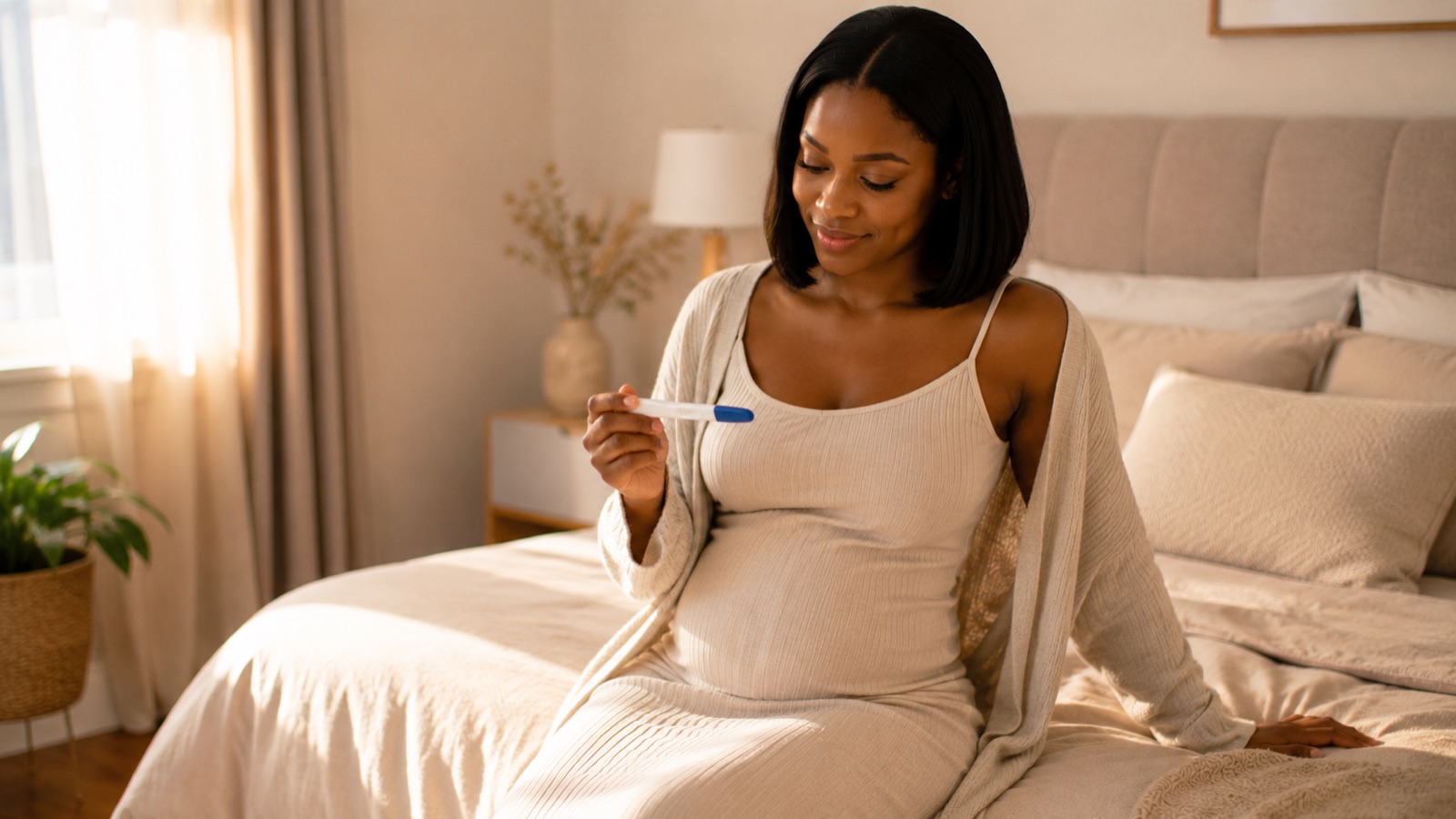
How a home pregnancy test works
Your body starts making hCG after the egg attaches to the wall of the womb. This usually happens about 10 days after conception. The Office on Women's Health says the amount of hCG then builds up quickly with each day of pregnancy. MedlinePlus puts the rise at "almost doubling every three days" for about ten weeks.
A test strip or stick is a piece of reactive paper that reacts to hCG in urine. Cleveland Clinic describes three ways to use one: put a few drops of urine from a clean cup on it, hold it in your urine stream, or dip it into urine in a cup. If enough hCG is there, a line, a plus sign or the word "pregnant" appears. If you test before enough hCG has built up, the test has nothing to find and shows negative, even when you are pregnant.
When to take the test
The Office on Women's Health says you can test as soon as the first day of a missed period. Cleveland Clinic says to wait until after you have missed your period for a more accurate result, because testing too soon can give a false negative. A missed period usually falls about 14 days after conception.
Some tests are sold as sensitive enough to use earlier. The Office on Women's Health says some newer, more expensive tests claim you can use them 4 or 5 days before your period is due, yet even they claim their best accuracy after the date of your expected period. It also points out that in up to 10% of women, the egg does not attach until after the first day of a missed period, so a test on that day can still be too early for some women.
If your periods are irregular. The Office on Women's Health counts periods as irregular when the gap between them is shorter than 21 days or longer than 35 days, or when it changes from month to month. Its advice is to count 36 days from the start of your last period, or four weeks from the time you had sex, and test then.
What time of day. MedlinePlus, Cleveland Clinic and the Office on Women's Health all say first morning urine is best, because it usually holds more hCG than urine later in the day. Cleveland Clinic adds that some tests are sensitive enough to work at any hour. If you test later in the day, it suggests waiting until at least three hours have passed since your last pee. MedlinePlus and Cleveland Clinic both say not to drink large amounts of water just before, because that can dilute the hCG.
How to take a strip or stick test, step by step
Methods differ from brand to brand, so the instructions inside your box always win. These are the main steps in the guidance we cite.
- Check the expiry date on the pack before you open it. MedlinePlus, Cleveland Clinic and the Office on Women's Health all say to do this.
- Read the instructions first. The Office on Women's Health lists three common methods: hold the stick in your urine stream, pee into a cup and dip the stick in, or pee into a cup and add a few drops with a dropper.
- Use first morning urine if you can, and do not drink a lot of fluid beforehand.
- Use a timer. MedlinePlus says that if you guess the timing, your result may not be accurate.
- Most tests show a result in about 2 minutes and brands differ, so follow your leaflet. The Office on Women's Health also says to wait up to 10 minutes after taking the test before you check the result window, because research suggests that gives the most accurate result.
Reading the result
First look for the control line. Most tests have a control line or symbol in the result window. It shows the test worked, and it should appear whether you are pregnant or not. If it does not appear, the test did not work and you need another one.
Then look for the test line. A line or plus symbol, no matter how faint, means the result is positive, says the Office on Women's Health. It adds that a faint line can mean you are early in the pregnancy and your hCG is still low.
Brands show a positive in different ways. Cleveland Clinic lists a plus sign, double vertical lines and the word "pregnant" as examples, so read your own leaflet to see which one yours uses.
A line that appears late. The sources we read give 10 minutes as the longest time to wait before reading. None of them explains how to read a line that shows up long after that. If a line shows up only long after the time your leaflet gives, treat the result as unclear and do not count it. Repeat with a fresh test, or ask a clinic.
What hCG level counts as positive. None of the pages we read gives one number. Cleveland Clinic says tests differ in how sensitive they are, so some show a positive sooner than others. Check your brand's leaflet for its own figure.
No matter how faint the line or plus sign, if you see it, you are most likely pregnant.
If the test is negative
A negative result does not always mean you are not pregnant. Cleveland Clinic says the main reason for a false negative is testing too early. Using too much or too little urine can also cause one, and the Office on Women's Health adds that problems with a pregnancy can change the amount of hCG in urine.
What to do next depends on the source. The Office on Women's Health says to take another test in a few days. MedlinePlus says to repeat it a week after the first one, because hCG rises every day in early pregnancy. Cleveland Clinic says that if you get a negative and then miss your period, test again. One early negative may be wrong, so repeat the test.
If two home tests are negative and you still think you are pregnant, MedlinePlus and the Office on Women's Health both say to call your doctor. A blood test can find smaller amounts of hCG than a urine test.
If the test is positive
A positive result is almost always right. Cleveland Clinic says a false positive is rare. The Office on Women's Health says to call your doctor or clinic to book an appointment, because a blood test can confirm the pregnancy and early care helps you and your baby stay healthy. Cleveland Clinic adds that the appointment may be several weeks away, and it is still worth booking now.
Cleveland Clinic also lists two other things to do after a positive test: start a vitamin that contains folic acid, and avoid alcohol and smoking. Our guide on folic acid benefits explains what folic acid does and how much the National Health Service recommends. Our due date calculator gives you a first estimate of your dates, and the antenatal appointment questions tool helps you prepare for that first visit.
A positive that is followed by a period. Cleveland Clinic says a false positive can happen with a chemical pregnancy, a loss soon after the egg attaches. If this has happened to you, our guide on chemical miscarriage explains it.
A positive does not say where the pregnancy is. Cleveland Clinic says an ectopic pregnancy still shows as positive on a pregnancy test. An ectopic pregnancy is one that grows outside the womb, usually in a fallopian tube. The National Health Service lists the warning signs as tummy pain low down on one side, vaginal bleeding or a brown watery discharge, pain at the tip of the shoulder, and discomfort when peeing or pooing. It says to get advice right away even without a positive test, and to treat a sudden, sharp, intense pain in the tummy, with dizziness or fainting, feeling sick, or looking very pale, as an emergency. If you have these emergency signs in Nigeria, go at once to the nearest hospital that gives emergency care.
What can change a home test result
The Office on Women's Health says most medicines do not affect a home test. That includes over-the-counter and prescription medicines such as birth control and antibiotics, and it says alcohol and illegal drugs do not affect results either. Cleveland Clinic agrees and adds pain relievers to the list.
The exception is medicine that has hCG in it. Some fertility treatments do, and they can give a false positive. MedlinePlus and Cleveland Clinic both say to talk to your provider about a positive result if you are taking fertility medicine, because the result may need to be verified with a blood test.
Tests without a kit, and online tests
The authorities we cite describe tests that find hCG in urine or blood. None of them describes salt, or any other kitchen test, as a way to check for pregnancy, and none describes a phone scan or an online quiz as one. A quiz can ask about your symptoms, but only a urine or blood test can find the hormone.
Early signs of pregnancy do exist. The National Health Service lists a missed period, a very light bleed around when your period is due, feeling or being sick, tiredness, tender breasts, needing to pee more often, constipation, more vaginal discharge, a metallic taste in the mouth, a sensitivity to smells, new cravings and mood changes. It says they usually start around 4 to 6 weeks of pregnancy, that not everyone has all of them, and that a test is how you find out.
Buying a test in Nigeria
The sources we used are from the United States and the United Kingdom, and they give no Nigerian prices, brand advice or local regulator guidance. So this guide gives no naira prices and no brand names.
What the sources say about buying a test is this. The Office on Women's Health and MedlinePlus say home tests are sold over the counter, with no prescription, and the Office on Women's Health says the price depends on the brand and how many tests are in the box. It advises talking to a pharmacist about which brand may suit you, and says to check the expiry date and follow the instructions on the pack. If the result stays unclear, contact a clinic or hospital. A healthcare professional may repeat the urine test or use a blood test.
When to see a doctor
- After any positive home test, to book your first appointment and have it confirmed.
- If two home tests are negative and you still think you are pregnant, or your period has not come.
- If you are taking fertility medicine and get a positive result.
- At once, if you might be pregnant and have tummy pain low down on one side, bleeding, pain in the tip of your shoulder, dizziness or fainting. Treat sudden, sharp, intense tummy pain as an emergency.
- If a result is unclear and you cannot tell whether the line is there.
Common questions
How soon can a test strip show pregnancy?
When is the right time to use a pregnancy test strip?
How do I take a strip pregnancy test?
How do you know if a strip pregnancy test is positive?
Does a faint line mean I am pregnant?
Can a pregnancy test be wrong?
Can I test my hCG level at home?
How can I tell if I am pregnant without a test?
Can I check pregnancy with salt, or on my phone?
Do medicines change a pregnancy test result?
Sources
- Pregnancy tests: when to test, how to use one, faint lines, irregular periods and false results, Office on Women's Health
- Pregnancy test: types, accuracy, first morning urine, false negatives and what hCG means, MedlinePlus
- Pregnancy tests: when to take one, how accurate, false results and what to do next, Cleveland Clinic, 2022
- Signs and symptoms that might mean you are pregnant, National Health Service
- Ectopic pregnancy: symptoms and when to get emergency help, National Health Service
Go further
The First Pregnancy Plan
A program and community for all pregnant women: week-by-week support, women at your stage, and a midwife or doctor to ask.
See the program →